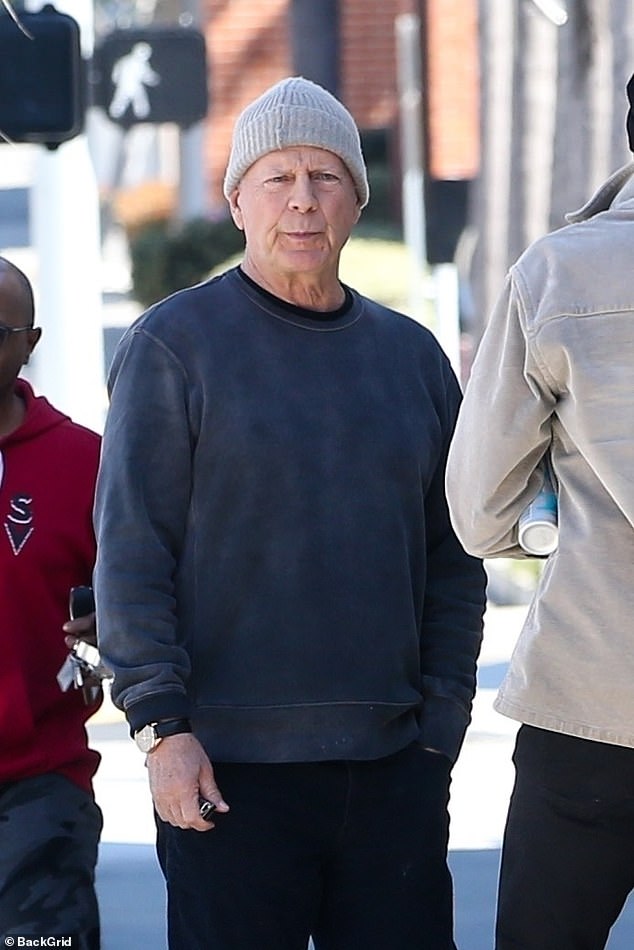
Bruce Willis was seen for the first time since his family revealed he had been diagnosed with frontotemporal dementia (FTD) last month – as the retired actor stepped out in Santa Monica on Thursday.
The Hollywood icon, 67, withdrew from acting last year as he began his fight with aphasia which caused his language abilities to deteriorate – with a joint statement from his family on February 16 confirming his condition had progressed to dementia.
Willis wore a blue sweater, black joggers and a woolen hat as he grabbed coffee with two friends on the outing in California.
FTD affects the lobes of the brain behind the forehead, which deal with behavior, problem-solving, planning and emotions – with symptoms including personality changes, obsessive behavior and speaking difficulties.
The statement, from his wife Emma Heming, ex-wife Demi Moore and five daughters and posted on The Association for Frontotemporal Degeneration’s website last month read: ‘Our family wanted to start by expressing our deepest gratitude for the incredible outpouring of love, support and wonderful stories we have all received since sharing Bruce’s original diagnosis.

Hollywood icon: Bruce Willis was seen for the first time since his family revealed he had been diagnosed with frontotemporal dementia (FTD) last month – as the retired actor stepped out in Santa Monica on Thursday

Public outing: Willis wore a blue sweater, black joggers and a woolen hat as he grabbed coffee with two friends on the outing in California
‘In the spirit of that, we wanted to give you an update about our beloved husband, father and friend since we now have a deeper understanding of what he is experiencing.
‘Since we announced Bruce’s diagnosis of aphasia in spring 2022, Bruce’s condition has progressed and we now have a more specific diagnosis: frontotemporal dementia (known as FTD).
‘Unfortunately, challenges with communication are just one symptom of the disease Bruce faces. While this is painful, it is a relief to finally have a clear diagnosis.
‘FTD is a cruel disease that many of us have never heard of and can strike anyone. For people under 60, FTD is the most common form of dementia, and because getting the diagnosis can take years, FTD is likely much more prevalent than we know.
‘Today there are no treatments for the disease, a reality that we hope can change in the years ahead. As Bruce’s condition advances, we hope that any media attention can be focused on shining a light on this disease that needs far more awareness and research.
‘Bruce always believed in using his voice in the world to help others, and to raise awareness about important issues both publicly and privately.
‘We know in our hearts that – if he could today — he would want to respond by bringing global attention and a connectedness with those who are also dealing with this debilitating disease and how it impacts so many individuals and their families.
‘Ours is just one family with a loved one who suffers from FTD, and we encourage others facing it to seek out the wealth of information and support available through AFTD (@theaftd, theaftd.org).

Devastating: The Hollywood icon withdrew from acting last year as he began his fight with aphasia which caused his language abilities to deteriorate – with a joint statement from his family on February 16 confirming his condition had progressed to dementia

Sighting: Willis spoke to a friend as the group grabbed coffee in LA

With friends: Willis spoke with his friends as the group got drinks and snacks

Outing: The Die Hard actor made his public outing two weeks after his dementia was revealed

Actor: Willis stepped out a year after he retired from acting due to aphasia

Outing: The actor was seen with his friends as he stepped out in LA

Walk: The star walked down the street with a friend who held two hot drinks

Beloved: The actor is among the most legendary Hollywood stars

News: Bruce Willis’ family said the star’s condition had ‘progressed’. FTD affects the lobes of the brain behind the forehead, which deal with behavior, problem-solving, planning and emotions (pictured with L-R wife Emma Heming, ex-wife Demi Moore and daughters Scout, Tallulah, Mabel, Evelyn and Rumer)

Family: Willis and his wife Heming Willis also have two daughters, Mabel, 10, and Evelyn, eight, together


Support: Celebrities including Ireland Baldwin and Aaron Paul sent well-wishes to the actor and his family

Together: Willis is pictured with his wife Emma Heming in a social media snap
‘And for those of you who have been fortunate enough to not have any personal experience with FTD, we hope that you will take the time to learn about it, and support AFTD’s mission in whatever way you can.
‘Bruce has always found joy in life – and has helped everyone he knows to do the same. It has meant the world to see that sense of care echoed back to him and to all of us.
‘We have been so moved by the love you have all shared for our dear husband, father, and friend during this difficult time. Your continued compassion, understanding, and respect will enable us to help Bruce live as full a life as possible.’
The statement was signed by Emma, Demi, and his daughters Rumer, Scout, Tallulah, Mabel, and Evelyn.
Willis shares Rumer, 34, Scout, 31 and Tallulah, 29, with Moore, 60 to whom he was married from 1987 to 2000. He also has two daughters, Mabel, 10, and Evelyn, 8, with his wife Emma, 44.
FTD occurs when nerve cells in the lobes behind the forehead die and the pathways that connect them change.
The left temporal lobe is involved in the meaning of words and the names of objects. The right recognizes faces and familiar objects.
Symptoms are different from just the memory loss that is associated with Alzheimer’s disease. These may include; personality changes, such as becoming tactless, uninterested in others and unsympathetic, repeated and compulsive movements, such as continued use of certain phrases, hoarding and obsession over timekeeping, craving unhealthy food and forgetting table manners, speaking difficulties, including slow speech, grammatical errors and asking the meaning of familiar words like ‘bread’.
Bruce’s blended family issued a joint statement at the end of March announcing that he was ‘stepping away from the career that has meant so much to him.’
The statement revealed he ‘has been experiencing some health issues and has recently been diagnosed with aphasia, which is impacting his cognitive abilities.’

Announcement: The family revealed earlier this year that the legendary actor was retiring from show business as his disorder effects his ability to speak and understand language

Willis is perhaps best known for his role in the Die Hard series as John McClane

Screen star: Willis played a psychiatrist in iconic 1999 picture, The Sixth Sense (pictured with Haley Joel Osment)

Action: Bruce Willis was a hit in the 1994 Quentin Tarantino film Pulp Fiction
The full statement read: ‘To Bruce’s amazing supporters, as a family we wanted to share that our beloved Bruce has been experiencing some health issues and has recently been diagnosed with aphasia, which is impacting his cognitive abilities.
‘As a result of this and with much consideration Bruce is stepping away from the career that has meant so much to him.’
The statement added:…